 Ethio-China Road, Addis Ababa, Ethiopia
 info@afcecd.org
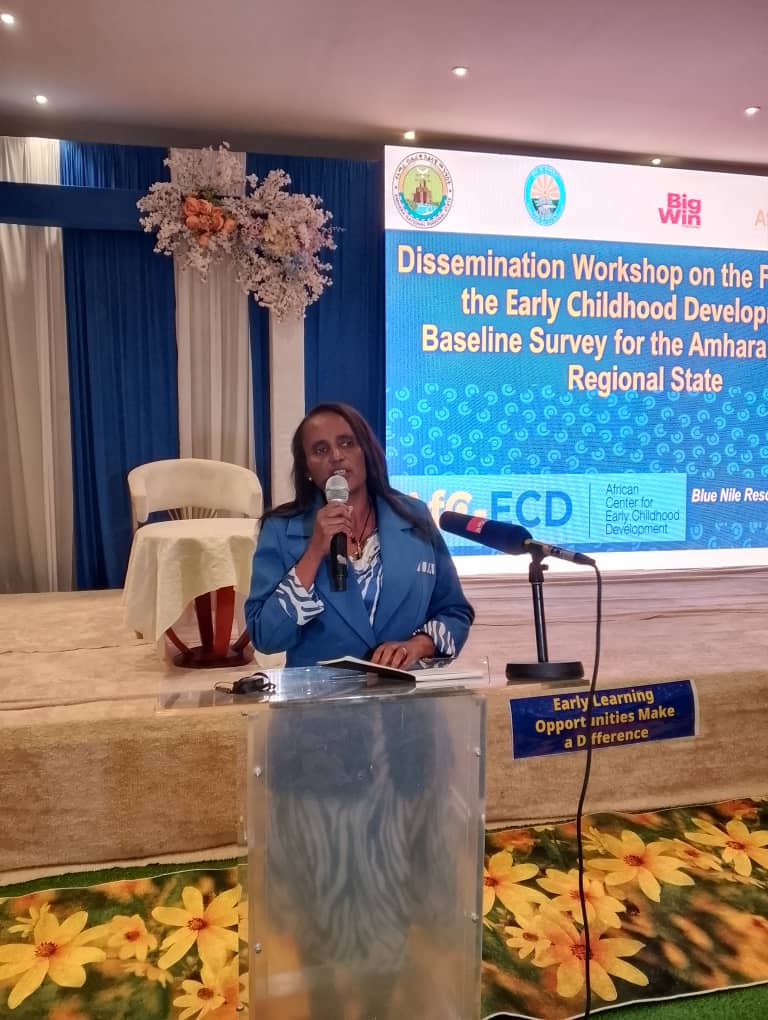
Amhara National Regional State Calls for Stronger Collaboration to Advance ECD
Bahir Dar, Ethiopia — November 30, 2025 — The Amhara National Regional State has called for stronger collaboration among stakeholders to advance Early Childhood Development (ECD) and ensure that children under the age of seven reach their full developmental potential.
The appeal was issued in Bahir Dar during the official release of a landmark baseline ECD survey conducted by the African Center For Early Childhood Development (AfC-ECD) in partnership with Bahir Dar University.
Opening the event, Dr. Mulunesh Desse, Deputy President and Head of the Regional Social Development Cluster, emphasized the urgency of modernizing Ethiopia’s approach to maternal and child care. She underscored the need for evidence-based ECD systems guided by science and reinforced the importance of community engagement.
Delivering welcoming remarks, Dr. Kebede Worku, CEO of AfC-ECD, described the release of the baseline survey as a “critical milestone” in the region’s efforts to strengthen child health, education, safety, and holistic development.
Dr. Kebede noted that the findings will guide the development of a comprehensive regional ECD strategic roadmap that sets priorities from conception to age six—ensuring access to quality early learning, adequate nutrition, safe environments, responsive caregiving, and integrated services within the health system. The roadmap will also support implementation, monitoring, and accountability efforts.
The survey’s detailed findings were presented by Dr. Sintayehu Abate, Senior Research Advisor at AfC-ECD, and Professor Netsanet Fantahun of Bahir Dar University. Dr. Sintayehu explained that the study covered major zonal towns and surrounding rural districts organized into six clusters.
The results reveal significant developmental risks across the region, driven by malnutrition, limited access to early learning, low parental education, and weak coordination among sectors. Notably, 21.7% of children under age three are developmentally off-track—more than four times the international benchmark of 5%. Rural children (23.1%) and those in low-income households (26.7%) are affected at even higher rates.
A panel discussion moderated by Dr Meseret Zelalem, Deputy Executive Officer of AfC-ECD, brought together officials from the Regional Social Cluster, Health, Education, and the Women, Children and Social Affairs Bureaus. Panelists discussed persistent ECD challenges and outlined priority actions for strengthening services and systems.
The study applied internationally validated research tools to assess service quality, parenting practices, and children’s developmental status. It was jointly conducted by the African Center for Early Childhood Development and Bahir Dar University Bahir Dar,Ethiopia, with financial and technical support from Big Win Philanthropy.